

Free Preview — 01.06: Roles in a Salesforce QA Team
Salesforce projects involve more than just “testers” — they include Test Leads, UAT Leads, and support roles that define how quality is delivered.
This lesson explains how these roles collaborate, where responsibilities overlap, and how testers can position themselves strategically within project structures.
If you want to grow professionally or understand team dynamics better, this lesson is essential.
Continue reading → (paid content below)
1. Introduction
Salesforce projects are multidisciplinary environments involving consultants, developers, architects, business analysts, and project managers — but among all these roles, QA is the only discipline that touches every part of the solution.
Understanding QA roles is essential not just for your personal development, but also for effective teamwork.
A Salesforce tester must know:
who is responsible for which decisions
where to escalate issues
how communication flows across the project
what expectations each role has from QA
how to provide value beyond executing test cases
This lesson explains the four core QA‑aligned roles you will encounter in Salesforce delivery:
Tester
Test Lead
UAT Lead
UAT Support
Even small differences in project structure can significantly impact test planning, communication, and responsibility boundaries. With this knowledge, you’ll navigate teams confidently and professionally.
---
2. The Tester — The Core Role of QA Execution
This is the starting point and the foundation of every QA team.
A Tester is responsible for:
validating each requirement delivered to the test environment
performing functional and end‑to‑end tests
ensuring test coverage based on requirement analysis
identifying gaps in documentation or business logic
reporting defects with clarity and precision
maintaining testing discipline (naming, data preparation, process consistency)
2.1 Daily Responsibilities
A tester must:
execute tests efficiently
prepare and maintain test data
verify technical configuration (fields, permissions, layouts)
follow testing levels and quadrants appropriately
communicate blockers early
support overall test quality and documentation
2.2 Responsibilities Beyond Testing
While testing is the primary duty, testers often support:
Jira hygiene (statuses, defect lifecycle, comments)
reporting progress to PM and Test Lead
updating test cases
clarifying requirements with consultants
early risk identification
2.3 Collaboration Expectations
A tester communicates with:
developers
consultants
business analysts
PMs
architects
UAT representatives
They do not work in isolation.
Strong testers openly ask questions, request clarification, and proactively engage when encountering inconsistencies.
---
3. Test Lead — The Owner of QA Processes
A Test Lead appears in medium and large projects where multiple testers need coordination.
This role combines execution with leadership, planning, and process oversight.
3.1 Responsibilities
In addition to testing, a Test Lead is responsible for:
defining and maintaining the test plan
coordinating test activities across the team
ensuring timelines are met
supporting testers in requirement analysis
reviewing test cases and documentation
resolving daily testing obstacles
representing QA in project‑wide discussions
3.2 Workload Balance
Depending on the project scale:
Sometimes Test Lead spends 50–70% of their time on coordination and 30–50% on testing.
In very large projects, hands‑on testing may drop below 20%.
This role requires balancing technical understanding with team management.
3.3 Communication & Escalation
The Test Lead is the first escalation point for:
PMs
Dev Leads
Functional Leads
Architects
If a defect is controversial or a process is unclear, the Test Lead is expected to handle the conversation.
---
4. UAT Lead — Ensuring Client Acceptance Success
UAT (User Acceptance Testing) is the phase where the client validates the delivered solution.
It is often the highest‑risk phase in the project lifecycle — and the point at which issues become visible to business stakeholders.
A UAT Lead acts as the bridge between the delivery team and the client during UAT execution.
4.1 Responsibilities
planning the UAT cycle with the PM and client team
preparing UAT strategy and timeline
coordinating the client’s testers
monitoring UAT execution and progress
analysing client defects and classifying them
identifying duplicates, misunderstandings, or low‑quality defect reports
determining whether a reported issue is:
a real defect
expected behaviour
requirement misunderstanding
missing test data on client side
environment issue
escalating critical issues to the development and consulting teams
4.2 Why QA Often Leads UAT?
Salesforce testers accumulate deep understanding of:
business processes
system behaviour
edge cases
risks
dependencies between automation layers
This makes them uniquely equipped to guide UAT execution efficiently.
---
5. UAT Support — Reinforcement for High‑Volume Projects
Some UAT phases involve dozens or even hundreds of test cases executed by large client teams.
One person cannot coordinate this alone.
A UAT Support role is introduced when:
the volume of reported issues is high
multiple parallel UAT streams run simultaneously
the client involves many testers of varying experience levels
5.1 Responsibilities
UAT Support:
monitors UAT defects alongside the UAT Lead
validates incoming defect descriptions
reproduces reported issues
performs initial classification
supports communication between client testers and the UAT Lead
However:
They do not make independent decisions.
All final classifications, escalations, and directions must be approved by the UAT Lead.
---
6. How the Roles Collaborate in Practice
Salesforce projects are iterative; roles blend naturally:
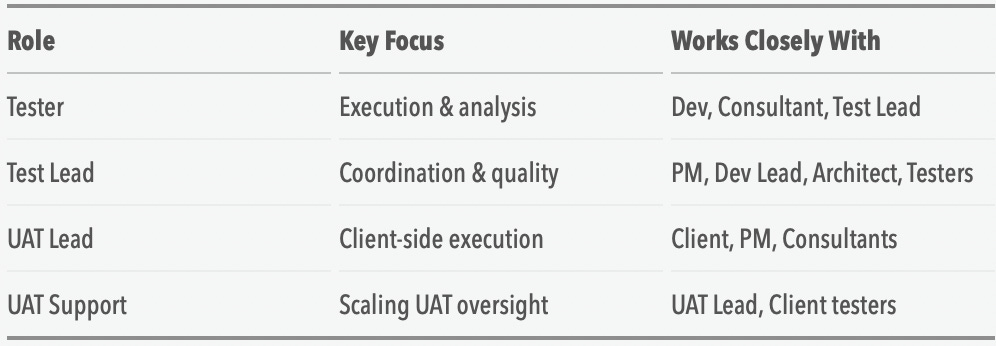
They form a testing ecosystem, not isolated functions.
7. Common Misunderstandings About QA Roles
Misconception 1: Testers only click test cases
Reality: testers perform deep analysis, identify gaps, and prevent defects.
Misconception 2: UAT is the client’s job and QA should not be involved
Reality: Without QA facilitation, UAT stalls within hours.
Misconception 3: Test Lead = people manager
Test Lead directs the testing process, not HR responsibilities.
Misconception 4: One tester can handle everything
Not true on complex projects with large automation stacks.
---
8. Summary
Salesforce QA operates in a dynamic environment involving multiple roles that must collaborate smoothly to ensure quality delivery.
Testers execute and analyse requirements.
Test Leads coordinate QA and maintain process discipline.
UAT Leads guide client acceptance and protect project timelines.
UAT Support scales the team during high‑volume UAT phases.
Understanding these roles helps you communicate effectively, manage expectations, and position yourself strategically within a Salesforce delivery team.
This knowledge also lays the foundation for more advanced modules where we dive deeper into requirement analysis, scenario construction, tooling, and real‑world project patterns.
---
End of Lesson 01.06